This entry is part 5 of 5 in the series The Transformers RPG review

(Translated with www.DeepL.com/Translator (free version))

The Origin of the character is thus mostly its chassis – the body, including the alt-mode. Eight are detailed in the base book, and they’re all fairly broad categories like “Champion” (racing-fast types), Seeker (aircraft), and Monolith (big types). Still, this is a breakdown that is reasonable and makes sense given what a franchise it is; I totally buy it.

Unfortunately, there are a lot of rules involved. I know there are probably many who would find this to be rules-light, but it’s my review so you’ll have to bear with me. Each Origin carries with it a basic attribute (Essence) increase, and there are limits to which one you can spend it on. You also get starter health, language (!) and some sort of unique “Origin benefit”.

Your bot mode and alt mode (the latter being the Transformers language for the thing you transform into) also get separate stats. Both get size and movement, and alt mode also gets max crew, firepoints (how many of the crew can sit and fire weapons) and any special attacks.

You are, however, completely free to decide exactly what you turn into. I find that very sympathetic and sensible – it could have been much worse. For example, each Origin could have had a list of, say, five vehicles: ‘choose one of these’ and then each of those choices could have given specific rule benefits… But no, your Origin tells you how big your alt mode is and how fast it moves and stuff, but the shape? It’s purely aesthetic. I like that.

Then, unfortunately, the descriptions of each origin are very colorless and uninspiring. You get a list of boring examples of chassit among established characters, what basic skill you can get better at, health, language… etc.

Well, I can’t really let go of this language thing. Of all the things to pick out to have your own stat for, and put a lot of text on, they pick… languages? When exactly was it important in Transformers whether a particular character speaks French?

Languages: Cybertronian, Adopted Earth language, plus one additional language for every 3 points of Smarts you possess.

That’s what it looks like, although which attribute provides the extra languages seems to differ.
In addition to those stats, they print under each origins bot mode that it has “fine motor”, which means it has fingers, and under each alt mode it says it has “limited articulation”. Fine motor takes three lines to describe, and limited articulation takes four. That’s seven extra lines for each origin. It may not be much, but it bothers me.

That “origin benefit” you get? It varies quite a bit in how much fun it is. Lookouts get the boring “+2 bonus to Evasion and can defend with Evasion even if you’re unaware of an attack” for example. Outriders get rid of negative modifications to rough terrain (yawn).

But Champion origins have “I know a bot”, which lets them spend an Energon Point to declare that they have a pre-existing positive relationship with an SLP. Including an enemy. It may not make them change their own goals, but they’ll probably go easy on you and maybe help you achieve one of your goals. That’s really fun!

(Have they explained what Energon Points are yet? Nah.)

But yeah, Origins is… fine. It could have been worse. And at least one of them has some quirky benefits.

(Then I have to ask: was it really justified to specifically include an origin for boat transformers? In the base book? How many are there even? Were any of the writers just really, really into Seaspray?)
This entry is part 4 of 5 in the series The Transformers RPG review

(Translated with www.DeepL.com/Translator (free version))

So, this is the best part of the game I’ve read so far. An Influence is kind of a background – the book has examples of being a bureaucrat, “cube player” (“cube” is like rugby), gladiator, etc. Each Influence has a perk, a list of potential Hangups, some Suggested Characteristics, and a table for Bonds.
You may choose up to three. For your first one, you only get the Perk; for the other two, you get both Perk and Hangup.

So; the Perk you get is normally some kind of really bad rule advantage. Like “you get ↑1 when you are pushed or try to get away from a Grapple”. No, they haven’t explained what ↑1 is, or what an Edge is, or what a Snag is. Yes, they use the terms liberally in the text as if we already knew. Yes, it’s annoying. No, game makers shouldn’t do that.

Hangups are more interesting. They can be things like “Mode attachment” that makes it actively difficult to switch to one of their forms, or “Whimsical” that makes you get ↓1 when you try to use the Inflitration skill other than for fun. It’s still just mechanics nonsense, but it’s a bit more fun mechanics nonsense because it actually creates some friction and the possibility for interesting problems. Of course, the best thing here would have been if there was some sort of opportunity to work on your hangups over time, but this game isn’t about character development other than in the sense of leveling up and getting better stats.

Anyway, Suggested characteristics are simply examples of how to roleplay the character. Often extremely obvious things; like on the level of what you’d get from an AI if you asked it to describe how you’d roleplay a… hunter, for example.

“Patience, confidence, and determination are all important characteristics of those who hunt. When a quarry is difficult to track, a hunter’s demeanor can mean the difference between a capture or an escape.”

No robot poop, robot Sherlock. I never would have figured that out.

Well, the good part of Influences, the one that is the best part of what I’ve read so far, is Bonds. Bonds are… Well. Things that are true about the character and that can both give character traits and further opportunities for quests, contacts and other things. Each Influence has twelve of these, and quite honestly they probably mean the thing I’ve read that has the ability to give the most breadth and variety to the characters aside from the pure combinatorics of Origin and Role. (Everyone with the same Role gets the same abilities at the same level, btw. You basically make no choices after character creation. But I’ll come back to that).

Some examples, from different tables:

  • Interpersonal relationships with my coworkers are difficult for me, as I am more focused on making the organization I’m part of run smoothly.
  • I am fascinated by Earth sports.
  • There is a symbol marked on my body as a result of an experimentation that I don’t know the meaning of, and I desperately want to find the maker who did it.
  • I carry a letter in a language I do not understand, found in my predecessor’s files. I hope to translate it and unravel its secrets.
  • I believe that I am a better leader than my direct superior.
  • My fabulousness cannot be overshadowed.
  • Human biology fascinates me.
  • I speak loudly, a habit from working in noisy environments all day.
  • There is no such thing as too many possessions, even if some think I’m a hoarder.
  • I have a hard time with authority and break traffic laws often.

So it’s quite mixed – some character prompts and some pure plot hooks that SL can pick up and do something fun with. This is a genuinely good idea, many of them are well written and interesting, and immediately make me feel like I want to play the character who has this Bond. I’m getting game-hungry.

Unfortunately, it’s also pretty much the only part of the character creation that makes me feel that way.

This entry is part 3 of 5 in the series The Transformers RPG review

(Translated with www.DeepL.com/Translator (free version))

This chapter is nine pages long and is mostly an overview of the process of creating a role model.

Once you’ve figured out your basic concept, you start to lay out some basic attributes (“Essences”) and skills. There are four asstributes, all named S-something: Strength, Speed, Smarts, and Social. You get a basic pot of 12 points now, and then you get another 4 from various sources for the rest of the process. 1 point gives +1 in an attribute, no wonder.

…except that, if I understand correctly, you never actually use your attributes for anything. Except to figure out your defenses. But ok, we’ll come back to that when we talk game mechanics.

Every point you spend on an attribute also gives you a point to spend on the associated skills. Does that mean you could basically spend points directly on skills and just use your total skills in a given category to figure out your defenses? Yes, I think so. Or, no. Because when you spend 1 point on a skill, you don’t get +1 in the skill; you upgrade a dice level. But we’ll come back to that too, because it’s not mentioned in this chapter. For now, we’re just talking about spending points on skills, not what those points actually do.

After the initial plotting of attributes and skills, you choose Influences. These are by far the best part of role character creation, so it’s a shame they’re barely described here. But at least they describe what the character thinks is important, what they are driven by and so on. You get a “Perk” from each influence, and if you choose more than one influence you “have” to choose a hangup for all of them after the first one. I put “must” in quotes because hangups are fun.

After your influences, you choose Race… or I mean “Origin”. Origin determines what kind of chassis you are – what you’re made for, what your alt mode is. Here you get new basic skill points and associated skill points. You also get basic health.

Already here we get a bit of foreshadowing about the system, because one of the things mentioned as a reasonable skill to have in a game about Transformers is what languages they know.

After choosing the ra… Origin, you choose the Class… um, “Role”. Your role determines what benefits you get when you level up, and now we also see that in addition to race and class, and basic abilities that are only used for defenses, we also have levels. This is starting to feel familiar.

But OK, every level you get a Perk from your Role, and sometimes you get other bonuses too. More on that when we read the Role chapter.

Once you’ve chosen your Origin and your Role, you can complete your plotting of basic abilities and skills, and figure out your defenses. Defenses are generally equal to 10 + the relevant basic skill. So if you have Strength 5, you have Toughness 15. Defenses are Toughness, Evasion, Willpower and Cleverness.

Finally, you choose equipment. I don’t recall equipment playing a particularly big role in Transformers – a lot of characters have some signature weapon or so, but like “gear” isn’t a particularly central part.

So… My impression after this chapter is that this is D&D with Transformers. Didn’t Fantasy Flight do just that a bunch of years ago? Mechamorphosis, like basically what d20 plus rules to transform?

(Here’s a spoiler: it’s not actually D&D straight up. It’s dumber, and worse. But more on that when I write about chapter 6).

This entry is part 2 of 5 in the series The Transformers RPG review

(Translated with www.DeepL.com/Translator (free version))

This chapter begins with a rather brief and concise summary of the basic elements of the transformer universe. This is done through diegetic texts written by Optimus Prime, Shockwave, Jetfire etc.

I’m certainly not sufficiently versed in all the Transformers timelines that exist, but I’m pretty sure this is a brand new one, where they simply picked a bit freely from different versions’ timelines and set of robots.

The short version is like this: Cybertron was ruled by the Function Council, which forced everyone to only work on things that suited their alt mode. Megatron was a gladiator who created a people’s movement that overthrew the Council, but once he did, he continued on – and became a tyrannical leader who fought the heroic Autobots.

When everyone began to run out of energy, he sent scouts out into the galaxy on Shockwave’s advice to find more. Jetfire was the Decepticon then, he was the one who found Earth where there’s a lot of potential energon. But instead of reporting to Megs, he deserted and became an autobot. Optimus and the rest of the Autobots went with the Ark to Earth, but were intercepted by Megatron and the Decepticons. Both ships crashed on Earth. Optimus made the decision that all autobots would become Earth vehicles like their alt-forms to fit in.

In addition to that history lesson, we also get some basic terminology.

Then we get EIGHT PAGES of short 4-5 line brief descriptions of various autobots. It’s very unclear what they’re for. “So that players know who to turn to when they want something” says the text, but far from all the descriptions contain anything roleplayers might want.

Throughout, the most boring version of each character has also been chosen. There is no blackness, no edginess, no real conflict. It’s sanitized, advertised… childish. And yes, I know this is a franchise of children’s toys from the beginning, but… that was 35 years ago. We who grew up are adults now, and we’ve read IDW’s amazing comics.

Is this game perhaps aimed at children? I don’t know, I don’t think so. The language might not be that complicated, but it does require a lot of prior knowledge. And… Well, even Marvel’s old G1 series had more nuances and more interesting character variations than this.

I think “inoffensive” is the word I’m looking for. This game presents a very inoffensive version of Transformers, making everything feel like superficial middlebrow with nothing to really engage with.

Well, we also get one (1) page, which I guess is this game’s equivalent of “what is roleplaying?” or “how do you play?”. Anyone who has played before can skip that page altogether, but anyone who hasn’t played role-playing games before won’t get much out of it either – it doesn’t explain how to play. You might just barely understand what an SL is and that you should create characters, but how it actually works – not mechanically, but how you talk around the table – I guess will be explained later.

Overall, we’re not exactly off to a good start. It’s not offensively bad, but it’s… boring. You can only play autobots. All autobots are good, all decepticons are evil. If a decepticon isn’t evil, then it’s really an autobot that switches sides (like Jetfire). There’s no room for any nuance here, something I’ve really been spoiled by IDW and even stuff like Prime and Marvel’s old G1 series. Back in the late 80’s, they relaxed these hard “good vs evil” boundaries and had sympathetic Decepticons. And unsympathetic autobots – Grimlock took over leadership of the autobots for a while and was bad to say the least.

By all means, imagine that all this is just autobot propaganda. That they would hardly talk about their own war crimes in their communiques. But… I think there’s a lack of support for that reading in what I’ve seen of the rest of the game. I’ll keep an eye out, but my impression is simply that they made as inoffensive a version as possible, and thus mostly got something that lacks personality and where there’s not much to grab onto as a roleplayer.

One can imagine that all this is just autobot propaganda. That they would hardly talk about their own war crimes in their communiqués. But… I think there’s a lack of support for that reading in what I’ve seen of the rest of the game. I’ll keep an eye out, but my impression is simply that they made as inoffensive a version as possible, and thus mostly got something that lacks personality and where there’s not much to grab onto as a roleplayer.

I also wonder who the target audience is. As I said, the “what is roleplaying” counterpart doesn’t really seem to be for anyone, and I get the same feeling in other parts. Complete obviousness that every old TF fan knows is explained in detail, while stuff like headmasters and targetmasters are mentioned in passing as if everyone knew what they were.

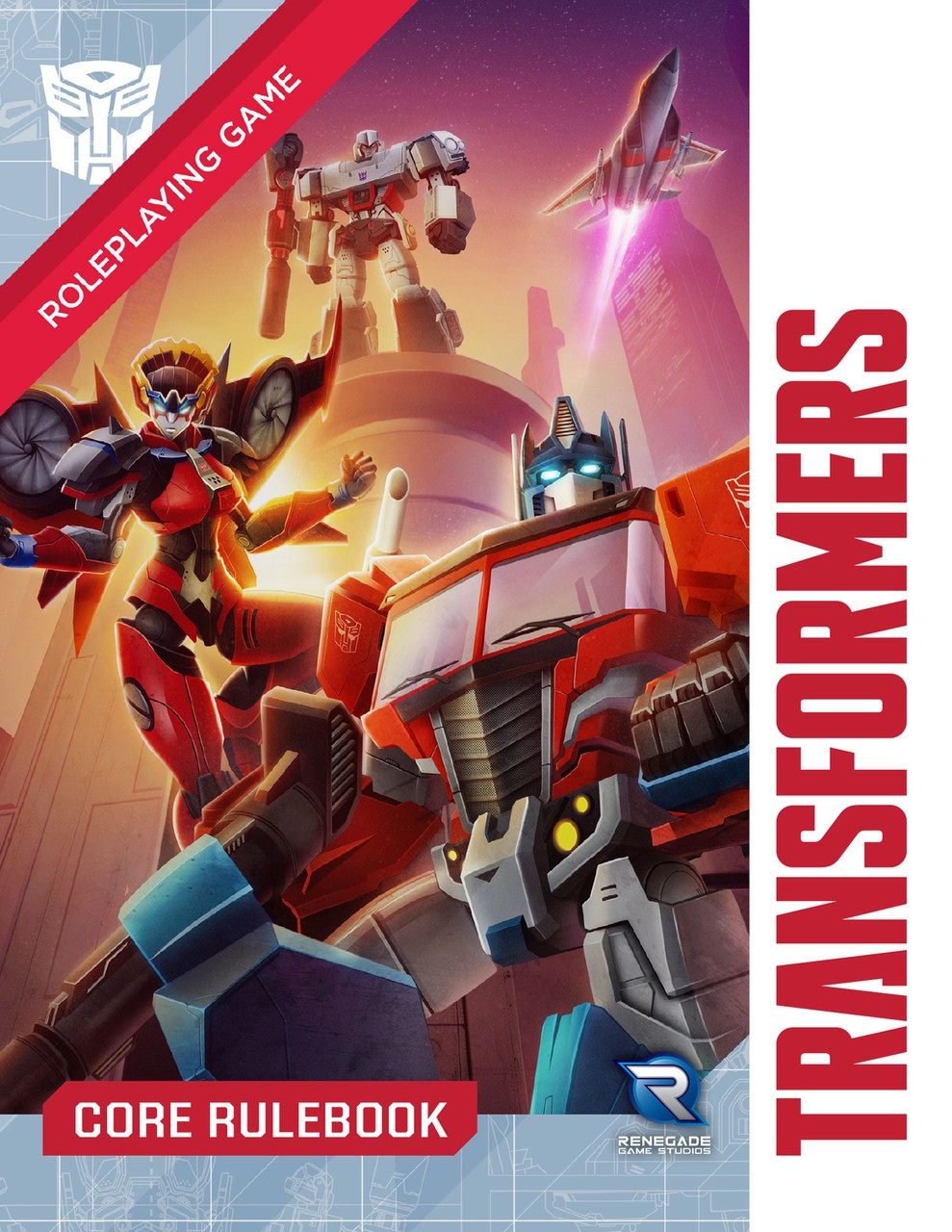
The illustrations so far are hugely dull, and in the same vein as Renegade’s Transformers card game. Good looking but completely devoid of personality. I’ve seen that they’re stealing some images from the IDW series going forward, and they’re certainly light years better looking.

The layout is… serviceable. I don’t like the patterned grey behind the text, but it still reads OK. The PDF has no layers (grrrr) so you have to endure. It’s not actively hard to read.

Next up is the chapter on creating the character. I suspect I won’t like it, based on what I’ve seen and heard…

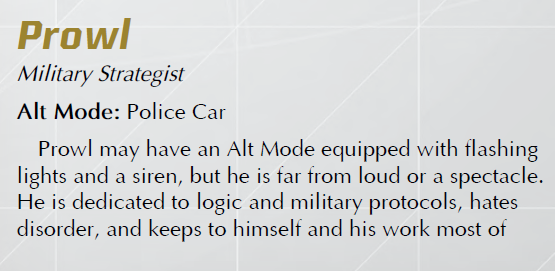
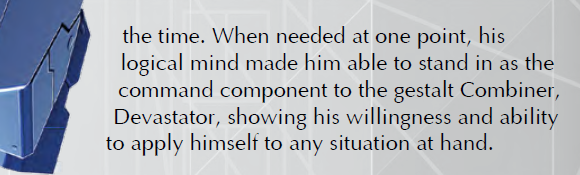
Does it say anything about Prowl being a completely ruthless war-damaged manipulative spymaster who no longer makes moral choices but only tactical ones with the goal of defeating the Decepticons and keeping the peace, regardless of whether he has to assassinate to achieve it? No. Does it say anything about him almost losing himself completely in the Devastator, and that he has since been plagued by nightmares and an unwelcome sense of belonging to the Constructicons? No. Anything interesting about him from IDW has been thrown out. Only the most superficial stuff – that he helped form Devastator – remains.

This entry is part 1 of 5 in the series The Transformers RPG review

(Translated with www.DeepL.com/Translator (free version))

One thing that many here already know about me is that I like Transformers. Not everything of course, I think few Transformers fans do. But I especially love IDW’s new comics and also Marvel’s old comics. I like the toys and have an inordinate number of plastic goblins bought in adulthood. I even like the Michael Bay movies. I think they may have negatives, but they’re a hell of a lot better than a lot of the old cartoons (fight me!).

Transformers is my first and strongest geek love. The franchise I’ve never been able to let go of, that I can’t really remember a time when I didn’t like. Robots that transform has been My Thing kind of… always.

Anyway, Renegade Studios announced a while back that they’ve been licensed to make role-playing games on a number of Hasbro properties, including GI Joe and Power Rangers and… Transformers.

That game was released not too long ago, so now I’ve bought it as a PDF and intend to read and write about it here. As with my Neotech thread, I’ll take a chapter or two at a time, and give my thoughts in stages. I’ll also be taking a break from all other roleplaying reading in the meantime. I’ve actually read one NeotechD chapter I should rewrite, so maybe I will, but I won’t read any more until this is over.

Me and licensed games have a, uh, not too positive history. I wrote about the Terminator RPG here. This is my list of things I normally expect from licensed games:

  • A world description that in no way invites role-playing, but is mostly a rather dull summary of the original. Kind of like a wiki page. “Here’s a timeline of the TV show’s seasons, a summary of the mythology, and stats for the main players”.
  • An undersized SL section that doesn’t really provide much help in how to actually create and structure your own adventures that feel like the original’s stories. If you’re lucky, you might get a brief passage on the dramatic curve.
  • A rules system that’s D&D-ish, by which I mean it’s pretty crunchy, entirely focused on combat, and with heavy emphasis on character stats and feats and such. I’m not saying that all D&D versions are like that, but that’s the feeling I got from the ones I’ve read. And no, OSR doesn’t count in here; I’ve mainly read D&D 3 and 4 =) But yes, at best maybe something more BRP-ish – still crunchy etc, but maybe without levels and supposed grid battles at least.
  • If the original has some unique feature (magic, for example) then there are unnecessarily complex subsystems that try to simulate that feature in detail. Maybe the original ran dramatic handwaving, but here we’re supposed to have at least four tables.
  • Illustrations taken straight from the original, even though they really only worked in context. Ugly screengrabs from a TV show are standard.
  • An intro adventure consisting of a corridor – a series of encounters one after the other with very little agency for the characters as to what they want to do. Presumably, most of these encounters are battle-ditones. There’s also nothing in the role-playing game as a whole to suggest that you’re expected to run any adventures other than just those.

…so in other words, basically my perhaps somewhat cynical expectations of trad games in general, plus a few things that are then specific to just licensed games.

I’ve already seen a youtube video about the game, where the person who made the video sounded enthusiastic but several of my expectations were met. We’ll see; I’ll try to read this game with kind eyes.

But I will say that when Renegade Studios charges $38 for the PDF, and $55 for the physical, and doesn’t have a bundle… they don’t exactly create a good breeding ground for goodwill.

I’m one of those who clearly could have spent a little extra to get both, but I’m not going to pay 970 bucks for the book+pdf. And $38 is an expensive pdf.

Anyways, on with the review – it will be split up into several posts; likely one per chapter or so. At time of writing, chapters 1–8 are already up on swedish RPG site rollspel.nu, and I’ll translate and add new chapters here whenever I have the time.